
Posts by admin
5 Reasons To Build Strong Employer Branding
Before diving into the reasons why building a strong employer brand is essential for recruitment, it’s important to define what an employer brand is. An employer brand represents the way a company is perceived as an employer, both by current and potential employees. It includes factors such as the company’s values, culture, reputation, and work environment.
Recruitment is critical for businesses because the quality of the workforce directly affects the success of the company. Hiring top talent can bring fresh ideas, diverse perspectives, and specialised skills to the table, leading to innovation and growth. On the other hand, hiring the wrong people can result in costly mistakes, missed opportunities, and a negative impact on company culture.
In today’s job market, where job seekers have access to a wealth of information about potential employers through social media, review sites, and other online platforms, building a strong employer brand is more important than ever. A positive employer brand can help attract and retain top talent, while a negative employer brand can deter candidates from applying and even damage the company’s reputation. Ultimately, a strong employer brand can help businesses stand out in a crowded and very competitive job market, attract the best talent, and retain valuable employees.
Attract Top Talent
Attracting top talent is directly related to strong employer branding as it is a key factor that candidates consider when deciding where to apply for jobs. A strong employer brand can help a company attract the best candidates.
A strong employer brand communicates to candidates that a company is a great place to work. This can be achieved by highlighting the company’s values, culture, and unique benefits, as well as showcasing the experiences and success stories of current employees. When candidates see that a company has a strong employer brand, they’re more likely to perceive it as a desirable place to work.
Moreover, a strong employer brand can help a company attract passive candidates – those who are not actively looking for a job but would consider a new opportunity if it came their way. When these candidates come across a company with a strong employer brand, they may be more likely to consider applying or accepting a job offer, even if they weren’t actively looking for a new job.
A strong employer brand can attract top talent in a few key ways:
- Creates a perception that a company is a desirable place to work
A strong employer brand can showcase the company’s values, culture, and unique benefits, highlighting why it’s a great place to work. This can be particularly important for top talent who are often looking for more than just a job – they want to work for a company that aligns with their values and offers opportunities for growth and development.
- Helps a company stand out in a crowded job market
When candidates are considering multiple job offers, a strong employer brand can be the deciding factor that sways them towards one company over another. A positive reputation can also help a company attract passive candidates who may not be actively looking for a job but are interested in working for a company with a strong employer brand.
Examples of companies with strong employer brands that attract top talent include Google, Apple, and Amazon. These companies are known for their innovative cultures, competitive salaries and benefits, and commitment to employee development. They’re also consistently ranked as top employers by organisations like Glassdoor and Forbes, which helps reinforce their reputation as great places to work.
Another example is Patagonia, a company known for its commitment to sustainability and social responsibility. Patagonia has a strong employer brand that attracts top talent who are passionate about making a positive impact through their work. The company has also been recognised for its employee-friendly policies, such as offering on-site childcare and flexible work arrangements.
Overall, companies with strong employer brands that attract top talent are those that have a clear and compelling value proposition, showcase their unique culture and benefits, and have a positive reputation in the job market.
Retain Current Employees
A strong employer brand not only helps attract top talent but also plays a crucial role in retaining current employees. When employees are proud to work for a company with a strong employer brand, they’re more likely to stay with the company long-term. A positive company culture, career development opportunities, and competitive compensation and benefits are all factors that contribute to employee satisfaction and retention.
Examples of companies with strong employer brands that have high employee retention rates include Southwest Airlines with employee turnover lower than 5% per year.
And did you know that out of all the employees at Salesforce, 66% would choose to stay with the company even if they were offered a higher salary elsewhere? Furthermore, an impressive 82% of Salesforce employees feel excited about going to work every day.
1923 employees have rated HubSpot’s Retention score as an “A+”, indicating the company’s strong focus and commitment towards retaining its employees. This score has remained consistently high at 87/100 over the past three months, further reinforcing HubSpot’s efforts to create a positive and fulfilling work environment for its employees.
These companies are known for their employee-friendly cultures, a strong commitment to employee development, and competitive compensation and benefits packages. They also prioritise employee well-being, offering benefits such as wellness programs, generous time off policies, and flexible work arrangements.
Another example is Zappos where employees stay with the company for an average of 3.1 years. They are known for their commitment to providing exceptional customer service and creating a positive work environment for employees. Zappos has a strong employer brand that has helped the company retain employees, many of whom have been with the company for years. The company offers unique perks such as free lunches, on-site fitness classes, and a fun and collaborative work environment that contributes to employee satisfaction and retention.
These companies understand that investing in employee satisfaction and retention is crucial for long-term success, and they have built strong employer brands that reinforce this commitment.
Increase Employee Engagement
When employees feel a strong connection to the company they work for and believe in its mission and values, they’re more likely to be engaged in their work and committed to the company’s success. A strong employer brand can also contribute to a sense of pride and ownership among employees, which can further increase engagement.
Examples of companies with strong employer brands that have high employee engagement rates include Airbnb, LinkedIn, and Wegmans. These companies are known for their strong company cultures, clear values and mission, and commitment to employee development. They also prioritise employee well-being and offer unique perks and benefits, such as flexible work arrangements, on-site gyms, and generous time off policies.
Another example is the outdoor clothing company, REI. REI has a strong employer brand that emphasises its commitment to sustainability and the outdoors. The company encourages employees to pursue their passions outside of work and offers unique perks such as “Yay Days,” where employees are encouraged to take a paid day off to pursue outdoor activities. This focus on employee well-being and connection to the company’s mission has contributed to high employee engagement and retention rates.
Stand Out from Competitors
A positive employer brand can differentiate a company and create a perception that it’s a desirable place to work. This can help a company attract top talent and increase employee retention rates. In addition, a strong employer brand can help a company build a positive reputation in the industry and among clients, which can further reinforce its position as a leader in the market.
An example of a company with strong employer branding that stands out in its respective industry is Netflix. Netflix is known for its unique company culture, which emphasises autonomy and employee empowerment. The company has a strong employer brand that has helped it attract top talent and become a leader in the streaming industry.
Netflix’s employer branding team, WeAreNetflix, has had to adjust its strategy due to COVID-19 and global Black Lives Matter protests. The brand was built to differentiate it from the consumer brand, and it has almost six million followers across social media platforms. Marquise McCoy, program manager of employer brand at Netflix, and Amir Moini, employer branding lead, discussed the pivots they made to showcase their culture with empathy.
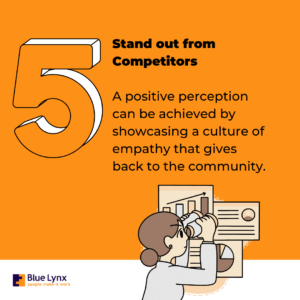
Firstly, they moved away from edgy branding and towards content that brings joy, inspires courage and feels relevant, particularly during the pandemic. The tone of the content had to change, and the team opted to focus on themes such as community, unity, and authenticity. An example of this was a screenshot from Brené Brown’s Netflix documentary, which resonated with people who had lost their jobs.
Secondly, the team prioritised content that gives back, such as informative webinars, and wanted to create content that gives actionable takeaways for people to apply to their lives or company. The leaders of some of Netflix’s employee resource groups discussed the role these groups play in the organisation, how they got started, and what conversations they’re having right now.
Thirdly, the team has made an effort to elevate Black voices and contribute to the Black Lives Matter conversation. They created a video in which Netflix employees discuss what being Black means to them, and they also held a panel discussion with Black creatives in animation about cultivating diversity and community in the future.
The WeAreNetflix brand was built to attract working professionals interested in joining the company, and as an external-facing brand, it reflects on Netflix as a whole. The team’s approach to employer branding has changed due to the events of the past year, and they have had to be aware of what’s going on in the world and match it appropriately. The team is dedicated to ensuring that the brand remains distinct and memorable and has focused on creating content that resonates with people during challenging times.
To Sum It Up
A strong employer brand can help attract top talent by creating a perception that the company is a desirable place to work. This can be achieved by showcasing the company’s unique culture, values, and benefits, as well as its commitment to employee development and well-being.
A strong employer brand can also help increase employee retention rates by creating a sense of pride and ownership among employees. When employees feel a strong connection to the company they work for and believe in its mission and values, they’re more likely to be engaged in their work and committed to the company’s success. Companies with strong employer brands that have high employee retention rates include Google, Wegmans, and Salesforce.
When employees feel that their work is meaningful and aligned with the company’s mission and values, they’re more likely to be engaged in their work and committed to the company’s success. A strong employer brand can help a company stand out in the market by differentiating it from its competitors. This can be achieved by showcasing the company’s unique value proposition, culture, and reputation, as well as its commitment to employee development and well-being.
Overall, building a strong employer brand is essential for businesses looking to attract and retain top talent, increase employee engagement, and stand out in their respective markets.
By showcasing their unique culture, values, and benefits, and prioritising employee development and well-being, companies can create a strong employer brand that reinforces their commitment to their employees and their mission.
Read MoreThe Connection between Sleep, Work, and Productivity

Sleep, work, and productivity are all interconnected and have a significant impact on each other. Lack of sleep can lead to decreased work performance and productivity, while a productive workday can often result in better quality sleep. In this article, we’ll explore the connection between sleep, work, and productivity, and how they can affect each other.
Sleep is a vital biological need in our daily lives. It is a restorative process that helps us recharge and prepare for the day ahead. A lack of sleep can have a significant impact on our cognitive abilities, physical health, and emotional well-being. Sleep deprivation can lead to decreased focus, memory, and attention span, which can result in decreased productivity at work.
In contrast, a good night’s sleep can improve our work performance and productivity. Research has shown that individuals who get enough sleep tend to be more productive, have better decision-making abilities, and are better able to handle stress. Additionally, sleep helps consolidate memories, which can aid in retaining information learned during the workday.
The impact of sleep on work and productivity
Sleep helps to restore both our physical and mental health.
The restorative process of sleep occurs during the deep, non-REM (rapid eye movement) stages of sleep, which typically make up about 75% of our total sleep time. During this time, the body undergoes a series of physiological changes that help our body’s restorative processes.
During sleep, the body releases growth hormone, which is essential for tissue repair and muscle growth. This hormone also helps to strengthen bones and promote healthy immune function.
Sleep also plays a critical role in sorting out our memories and learning. The brain consolidates and integrates new information, which helps to enhance learning and memory retention. This is why getting a good night’s sleep before a big test or presentation can improve performance.
Another essential function is to regulate emotions. Sleep helps to manage the production of neurotransmitters, such as serotonin and dopamine, which are essential for mood regulation and emotional well-being. Lack of sleep has been linked to an increased risk of depression, anxiety, and other mental health conditions.
During sleep, the body releases hormones that regulate hunger and satiety, such as leptin and ghrelin, which makes it vital for metabolism management and hormone production.
Looking for a healthy weight management approach? Perhaps you should start by assessing your sleeping habits first.
Unfortunately, many people do not get enough sleep, which can have serious consequences for their physical and mental health. Chronic sleep deprivation has been linked to an increased risk of obesity, diabetes, heart disease, and stroke, as well as mood disorders such as depression and anxiety.
Decreased cognitive abilities, physical health, and emotional well-being
Lack of sleep can have serious consequences for our cognitive abilities, physical health, and emotional well-being. Studies have shown that sleep deprivation can impair our ability to think clearly, make decisions, and focus our attention.
It can also lead to memory impairment and decreased cognitive performance. It can also weaken the immune system, making us more susceptible to illness and infection. Furthermore, sleep deprivation has been linked to mood disorders such as depression and anxiety, and can also impair our ability to regulate our emotions and cope with stress. Overall, getting enough quality sleep is essential for maintaining our physical and mental health, and for promoting optimal cognitive functioning.
Getting enough sleep can have a significant impact on our work performance and productivity. When we are well-rested, we are better able to focus our attention, make decisions, and think critically. This can lead to increased productivity and efficiency, as well as improved job performance.

Memory consolidation benefits
Memory consolidation plays a significant role in our ability to learn and retain information. During sleep, the brain processes and consolidates new information, strengthening neural connections and promoting long-term memory storage.
Studies have shown that sleep is particularly important for declarative memory, which is the type of memory used for learning and retaining facts and events. Good sleep also promotes the recall of memories, as the brain processes and integrates new information with existing knowledge. This process is essential for learning and cognitive development, as well as for the preservation of memories over time.
The impact of work on sleep
Job demands can have a significant impact on our sleep quality, leading to increased stress levels. High job demands, such as a heavy workload, tight deadlines, or frequent work-related travel, can create stress and anxiety, making it difficult to fall asleep or stay asleep throughout the night.
Additionally, job demands can lead to a lack of work-life balance, which can make it challenging to establish consistent sleep patterns and maintain good sleep habits. Over time, this can lead to chronic sleep deprivation, which can further exacerbate stress levels and increase the risk of physical and mental health problems. To promote healthy sleep habits and manage job-related stress, it is important to prioritise good sleep hygiene, establish a regular sleep routine, and practice relaxation techniques such as meditation or deep breathing exercises.
High-stress jobs, long work hours, and tight deadlines contribute to poor sleep quality
People who work in high-stress jobs, such as healthcare, emergency services, or finance, often experience elevated levels of anxiety, which can make it difficult to fall asleep or stay asleep throughout the night.
Additionally, long work hours and tight deadlines can create pressure to work late or sacrifice sleep to meet work-related demands, leading to chronic sleep deprivation. This can further exacerbate stress levels, making it even harder to maintain good sleep habits.
Over time, poor sleep quality can have serious consequences for physical and mental health, including an increased risk of obesity, diabetes, heart disease, and depression. To promote healthy sleep habits and manage job-related stress, employers need to encourage work-life balance, provide support for mental health and stress management, and establish policies that prioritise employee well-being.
Poor sleep quality leads to absenteeism and presenteeism
Poor sleep quality can have a significant impact on workplace productivity, leading to both absenteeism and presenteeism.
Absenteeism refers to the phenomenon of employees missing work due to illness or other factors, while presenteeism describes the situation in which employees come to work but are not fully productive due to illness or other factors.
Poor sleep quality can contribute to both absenteeism and presenteeism, as sleep deprivation can impair cognitive function, increase the risk of accidents and injuries, and reduce overall work performance.
Chronic sleep deprivation can also lead to physical and mental health problems, including depression, anxiety, and cardiovascular disease, which can further impact workplace productivity. To address the issue of poor sleep quality in the workplace, employers can offer support for employee well-being, such as flexible work schedules, access to mental health resources, and education on healthy sleep habits.
By prioritising employee health and well-being, as a part of the organisation’s culture, employers can help to reduce absenteeism and presenteeism, while also promoting a more productive and healthy workplace culture.
With good sleep hygiene, establishing a regular sleep routine, and practising relaxation techniques, you can increase your energy levels, improve cognitive function, and enhance work performance.
5 proven tips for better sleep
Establishing a regular sleep routine
A consistent sleep schedule helps to regulate the body’s internal clock, which promotes better sleep quality and promotes a sense of alertness during the day.
Best practices for establishing a regular sleep routine include setting a consistent bedtime and wake-up time, avoiding stimulating activities before bed, such as watching TV or using electronic devices, creating a relaxing sleep environment by keeping the bedroom cool, quiet, and dark, and avoiding caffeine and alcohol in the evening. Additionally, engaging in relaxation techniques such as meditation, deep breathing exercises, or gentle stretching can help to promote relaxation and improve sleep quality.
Avoiding electronic devices before bedtime
Did you know that according to a recent study by the Sleep Foundation, 75% of children and 70% of adults use electronic devices in bed?
The blue light emitted by electronic devices, such as smartphones, tablets, and laptops, can interfere with the body’s natural production of melatonin, a hormone that regulates sleep-wake cycles.

Exposure to blue light in the evening can suppress melatonin production, making it harder to fall asleep and stay asleep throughout the night. Additionally, engaging in stimulating activities, such as checking work emails or scrolling through social media, can increase mental stimulation and make it harder to unwind and relax before bed.
Relaxation techniques to reduce stress levels
To promote healthy sleep habits, it is recommended to avoid using electronic devices for at least 30 minutes before bedtime.
Practical relaxation techniques can be a great way to reduce stress levels and promote better sleep quality. One effective technique is deep breathing exercises, which involve taking slow, deep breaths and focusing on the sensation of the breath moving in and out of the body. This can help to calm the nervous system and reduce feelings of anxiety or tension.
Another useful technique is progressive muscle relaxation, which involves tensing and releasing each muscle group in the body, one at a time, to promote relaxation and reduce muscle tension.
Additionally, practising mindfulness meditation, yoga, or gentle stretching can help to promote relaxation and reduce stress levels. Other practical techniques include listening to calming music, taking a warm bath, or engaging in a creative hobby, such as drawing or writing.
Flexible work schedules, allowing for naps or breaks, promoting work-life balance
Before the pandemic, only 8% of companies had flexible workplace policies, but now, 62% of employees report that their company has implemented some degree of flexible work.
Flexible work schedules, allowing for naps or breaks, and promoting work-life balance are all effective ways for employers to promote employee well-being and improve productivity.

Allowing employees to have a flexible work schedule can help to reduce stress levels and promote work-life balance, as it enables people to better manage their personal and professional responsibilities.
Additionally, offering the opportunity for naps or breaks during the workday can help to promote alertness and reduce fatigue, which can improve overall work performance.
Employers who support employee well-being and promote work-life balance, create a more positive and healthy work environment, which can lead to increased job satisfaction, improved employee retention rates, and overall productivity.
To sum it up
Poor sleep quality can have negative effects on job performance, including decreased cognitive abilities, physical health issues, and emotional well-being. In contrast, healthy sleep habits, such as establishing a regular sleep routine and avoiding electronic devices before bedtime, can lead to increased productivity, improved cognitive function, and enhanced work performance. Employers need to implement workplace policies that promote employee well-being, including flexible work schedules, breaks, and support for work-life balance. This can improve workplace productivity, create a more positive work environment, and enhance overall health, and physical and emotional well-being.
Read MoreAttracting Talent and Driving Innovation: The Role of Sustainability in Modern Business
Sustainability has become a buzzword in modern business and for good reason. Аccording to the International Energy Agency, global CO2 emissions from energy use rose by 1.5 billion tonnes in 2021, reaching a new all-time high.
With the effects of climate change becoming more apparent each year, businesses have a tremendous responsibility.
The role of sustainability in modern business is multifaceted. On one hand, businesses have a responsibility to reduce their environmental impact, both in terms of greenhouse gas emissions and waste. This can involve a range of strategies, from using renewable energy sources, reusing or recycling, to reducing waste in the production process. These strategies not only benefit the environment, but they can also save businesses money in the long run.
Sustainability also plays a crucial role in meeting the expectations of consumers. Today’s consumers are more environmentally conscious than ever before, and they expect the businesses they patronise to reflect those values. By incorporating sustainability into their business practices, companies can appeal to this growing market and differentiate themselves from competitors.
In addition to meeting consumer expectations, sustainability can also be a key driver of innovation and growth. As companies seek to reduce their environmental impact, they are forced to think creatively and come up with new solutions to old problems. This can lead to the development of new products and services, as well as new business models that prioritise sustainability.
Sustainability and businesses in the Netherlands
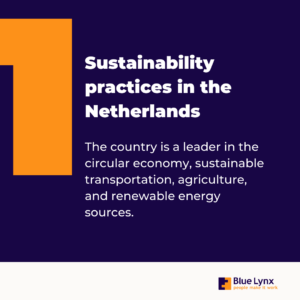
The Netherlands is known for its sustainable policies and practices, and sustainability is becoming an increasingly important issue for businesses operating in the country.
The Dutch government has set ambitious sustainability goals, including a target to reduce greenhouse gas emissions by 49% by 2030. The government also provides subsidies and other incentives to encourage businesses to adopt sustainable practices.
The country is also a leader in the circular economy, which focuses on minimising waste and maximising the use of resources. Many Dutch businesses are working to create products and services that can be reused, repaired, or recycled.
Sustainable transportation
The Netherlands is known for its bike-friendly culture and has invested heavily in sustainable transportation infrastructure. Many businesses encourage their employees to bike or use public transportation to reduce their carbon footprint.
Sustainable practices expand to agriculture agricultural products as well. Many Dutch farms are adopting practices like precision agriculture and using renewable energy sources to reduce their environmental impact.
Sustainable building
The Netherlands is home to some of the most sustainable buildings in the world. According to the US Energy Information Administration, commercial buildings consume 19% of all energy used in the United States.
In contrast, many Dutch businesses are incorporating sustainable building practices. For example – using energy-efficient materials and renewable energy sources, in their facilities.
How is sustainability connected to recruitment?
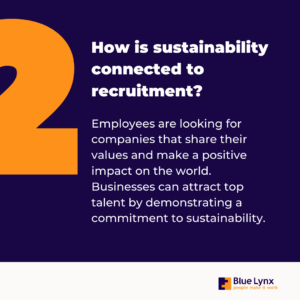
Sustainability is becoming increasingly important to job seekers, particularly among younger generations, and can impact a company’s ability to attract and retain talent.
Here are a few ways in which global business and sustainability are connected to recruitment:
- Attracting job seekers
Companies that prioritise sustainability may be more attractive to job seekers who are looking for a sense of purpose and want to work for an organisation that aligns with their values. By highlighting their sustainability efforts in job postings and recruitment materials, companies can attract candidates who are passionate about sustainability and are a right cultural fit as well.
- Employee engagement
Employees who are engaged in sustainability efforts may be more motivated and committed to their work. By involving employees in sustainability initiatives and making them a part of the company culture, companies can increase employee satisfaction and retention.
- Reputation
Companies with a strong commitment to sustainability may have a better reputation among clients, investors, and other stakeholders. A positive reputation can attract job seekers who want to work for a company with a strong brand and may help companies stand out in a competitive job market. For example, according to a survey by Cone Communications, 81% of consumers say that they would be more likely to purchase a product if a company makes a strong commitment to social or environmental issues.
- Innovation
Sustainability can drive innovation, and companies that prioritise sustainability may be more innovative and forward-thinking in their approach to business. By attracting innovative employees, companies can stay ahead of the curve and remain competitive in their industry.
Sustainability plan for your business
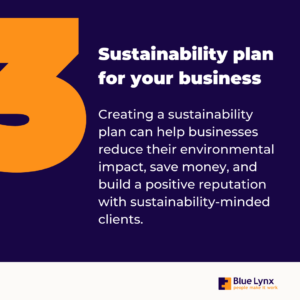
Creating a sustainability plan for your business can help you reduce your environmental impact, save money, and build a positive reputation with customers who care about sustainability.
Firstly, it’s advisable to assess your current environmental impact.
Did you know that according to the United Nations, global demand for freshwater is projected to exceed supply by 40% by 2030?
Conduct a comprehensive audit of your business operations, including energy and water usage, waste generation, transportation, and supply chain. This will help you identify areas where you can make improvements and set sustainability goals – short and long-term ones. Based on your assessment, set realistic and measurable goals for reducing your environmental impact.
Your goals should be specific, measurable, achievable, relevant, and time-bound (SMART).
Once you have set your goals, develop a strategy to achieve them. This may involve implementing new processes or technologies, changing behaviour, or partnering with suppliers who share your sustainability values.
Your employees are key to implementing and sustaining your sustainability plan. Engage them in the planning process, educate them on sustainability practices, and incentivise them to make changes in their behaviour.
Once the sustainability plan has been established, you need a system for tracking progress toward your goals. This will help you identify areas where you are making progress and where you need to make improvements.
Share your sustainability plan and progress with your customers, employees, and stakeholders. This will help build trust and loyalty and may attract new clients with whom you’d share a common goal.
Continuously improve: Sustainability is an ongoing process. Regularly evaluate your sustainability plan and adjust it as needed to ensure that you are making progress and achieving your goals.
5 Ideas for sustainable practices to involve employees
If your business is keen to adopt a sustainability plan but you don’t know where to start:
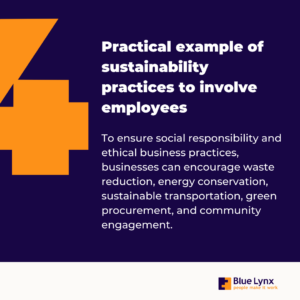
Here are some practical examples of sustainability practices that can involve employees:
- Waste reduction
Encourage employees to reduce waste by providing recycling bins, reusable mugs and water bottles, and implementing a “paperless” policy where possible. Consider holding a waste reduction challenge or competition to encourage participation and generate excitement around sustainability.
- Energy conservation
Encourage employees to conserve energy by turning off lights and electronics when not in use, using natural light whenever possible, and adjusting thermostats to save energy. Consider implementing an energy audit to identify areas for improvement and involve employees in the process of finding solutions.
- Sustainable transportation
Encourage employees to use sustainable transportation options, such as biking, walking, or taking public transit. Did you know that almost 700 million metric tons of CO2 pollution can be saved yearly if everyone rode their bikes every day like the Dutch? Provide bike racks and shower facilities for employees who bike to work, and consider offering incentives or rewards for employees who use sustainable transportation options.
- Green procurement
Involve employees in the procurement process by encouraging them to consider sustainability factors when purchasing products and services. This can include choosing suppliers with strong sustainability policies, selecting products made from sustainable materials, and reducing packaging waste.
- Community engagement
Involve employees in sustainability initiatives that benefit the community, such as volunteering for local environmental organisations, participating in community clean-up events, or supporting sustainable agriculture initiatives. This can help to build a sense of purpose and engagement among employees and can also help to improve the company’s reputation in the community.
Overall, involving employees in sustainability practices requires a commitment from company leadership and a clear strategy for engaging employees. By providing education, empowerment, and recognition, companies can create a culture of sustainability that drives positive change and engages employees in the process.
Nowadays, sustainability is not just another greenwashing term – it’s a necessity for modern businesses. By incorporating it into their business practices, companies can reduce their environmental impact, meet consumer expectations, drive innovation, and attract top talent.
To effectively incorporate sustainability into their business practices, companies must take a holistic approach. This includes not only reducing their environmental impact but also ensuring that their business practices are socially responsible and ethical. This can involve strategies such as paying fair wages and ensuring safe working conditions for employees, as well as engaging with and giving back to local communities.
But sustainability is more than just a business strategy – it’s a lifestyle and a way of thinking, and operating that prioritises both financial success and social responsibility. Businesses that embrace sustainability can create a competitive advantage that will benefit them for years to come and leave behind a better world for the next generations.
Read More7 most common interview questions in 2023

Job interviews are an essential aspect of the hiring process, and they can be a daunting experience for many job seekers. But what if we told you that there’s a hack that can help you ace your next interview?
Being prepared for a job interview is important as it shows your interest in the position and makes a great first impression. When you are well-prepared, you demonstrate that you’ve done your due diligence and have taken the time to understand what it entails. Furthermore, a well-prepared candidate appears more confident, articulate and knowledgeable.
It also helps you to anticipate and prepare for difficult questions: By researching the company and the job, you can anticipate the types of questions that you may get and prepare thoughtful responses that demonstrate your qualifications and fit for the job.
Overall, being prepared for a job interview is crucial if you want to increase your chances of landing it.
There are some common interview questions that you can prepare in advance to increase your chances of landing the job of your dreams. In this article, we’ll explore seven of the interview questions that you can expect to face most often in 2023.
Can you tell us a little about yourself?
Understanding why people ask a particular interview question is key to crafting an impressive answer.
This question is almost always the first question that’s asked in an interview. It’s an opportunity to introduce yourself and give the interviewer a sense of who you are.
This question is also purposed to help ease into the actual interviewing process, especially for less experienced recruiters. What’s more, it can help inform the direction of the interview and facilitate a smooth flow of conversation. If answered well, the interviewers will get to know you better and assess your fit for the job based on both hard and soft skills. This is a great opportunity to showcase your communication skills, and ability to connect with others and present yourself professionally.
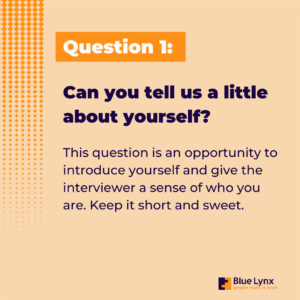
Keep your response concise and focused on your professional experiences, skills, and accomplishments. Avoid sharing personal details or unrelated hobbies.
One potential response could be: Sure, I’d be happy to share a bit more about myself. My name is [Your Name], and I’m excited to be interviewing for this position. I have a degree in [Your Degree] from [Your University] and have worked in [Your Industry] for [Number of Years] years. In my current role as [Your Current Role], I have been responsible for [Your Key Responsibilities].
Outside of work, I enjoy [Your Hobbies or Interests], which I find helps me maintain a healthy work-life balance. I am also committed to continuous learning and development and have attended workshops and training sessions related to [Your Skills or Industry].
Overall, I am passionate about [Your Industry or Field] and am excited about the prospect of bringing my skills and experience to this role. I believe that my [Your Key Skills or Qualifications] make me a strong candidate for this position, and I am eager to discuss how I can contribute to the success of this company.
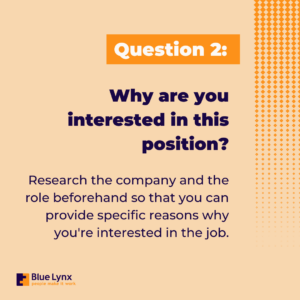
Why are you interested in this position?
This question is designed to assess your level of interest in the position and the company.
Take your time to research the company and the role before the interview so that you can provide specific reasons why you’re interested in the job. This could be the company’s reputation, opportunities for growth and development, or the chance to work with a particular team or project.
When applying for a job, it’s crucial to showcase your passion and motivation for the position to the interviewer. Ultimately, If you’re not passionate about the role, you may want to reconsider applying for it.
Here’s an example answer:
Thank you for asking. I’m very interested in this position because I believe that it is an excellent match for my skills and experience, and aligns well with my career goals. I’ve done some research on the company and the role, and I’m impressed by what I’ve seen so far.
I’m excited about the company’s mission and values, and I believe that this position would provide me with an opportunity to contribute to the success of the company while also allowing me to grow and develop my skills.
Additionally, I’m drawn to the specific responsibilities of this role, such as [list a few specific responsibilities that you find appealing]. These responsibilities align with my experience and interests, and I’m confident that I could excel in this role.
Overall, I’m very excited about the opportunity to work for this company and contribute to its success, and I believe that this position is the perfect next step in my career.
Essentially, you aim to show your enthusiasm for the position and the company. By highlighting your relevant experience and passion for the role, you can set yourself apart as a strong candidate for the job.
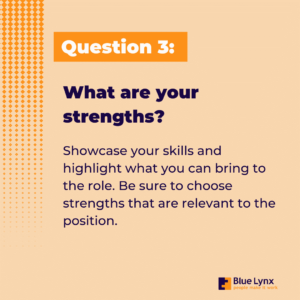
What are your strengths?
This question is an opportunity for you to showcase your skills and highlight what you can bring to the role.
Aim to choose strengths that are relevant to the position that you are applying for. If you’re applying for a marketing role – spotlight your creativity, communication skills, and ability to analyse data with a critical eye.
A generally good practice is to thoroughly review the job description before the interview. This will enable you to discuss the “Must Have” or “Required” skills as part of the conversation about your strengths.
An example answer could look like this: “When asked about my strengths, I tend to focus on my ability to collaborate well with others, my strong problem-solving skills, and my attention to detail. I value teamwork immensely, and I believe that by working together, we can achieve more as opposed to working individually.
I am always open to others’ perspectives and ideas and I proactively contribute with my thoughts. My previous experiences have allowed me to develop a good critical thinking approach. What is more, I am confident in my ability to analyse complex situations and find effective solutions whilst assessing all relevant factors.
Lastly, I take great pride in my attention to detail. I understand that small errors can have a detrimental impact on the outcome. Therefore, I always make sure to thoroughly review my work. Overall, I believe that my strengths in collaboration, problem-solving, and attention to detail make me a valuable asset to any team.
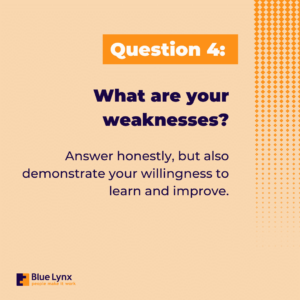
What are your weaknesses?
When asked about your weaknesses during a job interview, it is important to answer honestly, but also demonstrate your willingness to learn and improve. Here are some tips for answering this question effectively:
- Choose a weakness that is not directly related to the job you are applying for.
For example, if you are applying for a job in customer service, do not mention that you have difficulty speaking to customers.
- Be honest and specific
However, make sure you don’t dwell on it. Instead, focus on how you are working to improve it. For example, you could say something like, “One area I am working to improve is my public speaking. I have joined a local educational organisation and have been practising regularly to build my confidence.”
- Show that you are proactive in addressing your weakness.
Discuss steps you are taking to overcome it, such as taking a course, seeking mentorship, or practising on your own.
- Emphasise your strengths
And most importantly, how they balance out your weakness. For example, you could say, “While public speaking is not my strongest area, I excel in research and analysis, which allows me to prepare thoroughly for presentations and deliver a clear message.”
- Be confident and positive in your response
Remember, everyone has weaknesses, and the interviewer is not looking for perfection, but rather for candidates who are self-aware and willing to learn and grow.
Tell us about a challenge that you were able to solve at work.
When asked to talk about a challenge that you were able to solve at work during a job interview, it’s important to provide a detailed and structured response.
The best way to do that is to provide context. Start by providing a brief overview of the challenge and the context in which it occurred. This will help the interviewer understand the situation and the specific problem you were facing.
Next, describe your approach and explain the steps you took to address the challenge. Be sure to highlight any creative or innovative solutions you developed.
What about your skills?
Discuss the skills you used or developed during the process. This could include things like problem-solving, communication, teamwork, leadership, or other relevant ones.
What was the outcome?
Share the positive outcome of your efforts, including any measurable results. This could be an improvement in efficiency, increased revenue, or positive feedback from colleagues or customers.
What did you learn from this experience?
Finally, reflect on what you learned from the experience and how you have applied those lessons in your work since. This shows that you are adaptable, reflective, and constantly seeking to improve.
Example Response:
One challenge I faced in my previous job was a major project that was behind schedule and over budget. To address this, I organised a team meeting to identify the root cause of the issue. We realised that there were communication breakdowns between different departments. Those were leading to duplication of work and missed deadlines. To solve this, I set up a system of regular team meetings and check-ins to ensure that everyone was on the same page and that issues were addressed promptly.
As a result of these changes, we were able to get the project back on track and ultimately completed it under budget. This experience taught me the importance of effective communication and project management skills, and I have continued to apply those lessons in my work since then.
Why should we hire you?
When asked, “Why should we hire you?” during a job interview, it’s important to provide a confident and well-thought-out response.
- Highlight your strengths
This is an opportunity to showcase your unique skills and strengths that make you the best candidate for the job. You can mention specific accomplishments or experiences that demonstrate your abilities.
- Show how you will add value
Make sure to emphasise how you will contribute to the company’s goals and objectives. This could be through your expertise, experience, or enthusiasm for the role.
- Research the company
By researching the company and its culture, you can tailor your response to align with its values and mission. This shows that you are interested in the job and have done your homework.
- Be confident
Speak with confidence and conviction. Show the interviewer that you believe you are the right fit for the job and are excited about the opportunity.
Here’s an example response:
“Based on my experience in this industry and my understanding of the company’s goals and values, I believe I would be a great fit for this position. I have a track record of successfully managing projects and teams, and I am confident that I can bring my skills and expertise to help the company achieve its objectives. What’s more, I am passionate about this industry and I believe my enthusiasm and drive would make me a great asset to the team.”
Do you have any questions for us?
At the end of the interview, the interviewer will likely ask if you have any questions. Always prepare a few questions in advance. This shows that you have done your research and are genuinely interested in the role and the company. Ask about the company culture, its mission and vision, opportunities for growth, or specific projects that the team is working on.
This is a good opportunity to ask any clarifying questions if you have any doubts about the job responsibilities or other aspects of the role that you are unsure about.
Focus on the future – ask about the company’s plans for the future and how the position fits into those plans. This shows that you are interested in the long-term growth of the company.
Lastly, It’s generally best to avoid asking about salary and benefits during the first interview. This can come across as presumptuous and may give the impression that you are more interested in the compensation than the job itself.
Here are some example questions you could ask:
Can you tell me more about the company culture and how employees work together?
What are the main goals for the company in the next year or two?
Can you describe the typical career path for someone in this role?
How does the company foster professional development and growth for its employees?
Remember, asking thoughtful questions not only shows your interest in the company but can also help you gain a better understanding of the role and whether it’s a good fit for you.
To sum it up
Job interviews can be daunting, but by preparing for the most common questions, you can increase your chances of success.
Our tips on how to answer the most common job interview questions emphasise the importance of preparing beforehand and practising your responses. Make sure you focus on your strengths and how they align with the company’s needs when answering questions such as “Why should we hire you?” and “What are your greatest strengths?”.
When answering questions about weaknesses, go ahead and acknowledge them. As long as you explain how you are working to improve, you’ll make a positive impression. For the question “Tell me about yourself,” you can provide a brief overview of your relevant experience and skills. Always ask thoughtful and well-prepared questions, and when given the opportunity, show your genuine interest in the position and company.
Lastly, remember to do your due diligence about the company and the role. Be sure to choose relevant examples when answering questions, and always be honest. With a bit of preparation and practice, you can ace your next interview and land the job of your dreams.
Read MoreWhat is toxic productivity and can we overcome it

What is toxic productivity?
Productivity is often seen as a positive attribute, one that is essential for success in both personal and professional life. It is a measure of how efficiently and effectively we can get things done. However, the pursuit of productivity can sometimes have negative consequences, leading to what is known as “toxic productivity.”
Toxic productivity refers to the phenomenon where the obsession with being productive becomes harmful to our well-being. This can manifest in many ways, such as constantly pushing ourselves to do more, even when tired or sick. To make it worse, it can also progress into neglecting self-care and sacrificing personal and professional relationships for the sake of getting things done.
One of the reasons toxic productivity is becoming more prevalent is the pressure society places constantly pushing us to perform and achieve. With the rise of the gig economy and remote work, the lines between work and personal time have become blurred. Regrettably, this has made it easy for people to fall into the trap of working around the clock. Additionally, the growing emphasis on productivity as a measure of success and worth can lead to adopting poor self-care habits. For instance, it can mean becoming overly focused on checking items off our to-do lists, rather than taking the time to rest and recharge amongst others.
What causes toxic productivity
In today’s fast-paced and competitive world, we are under constant pressure to be productive and to achieve success in all aspects of our lives.
One of the main causes of toxic productivity is the belief that one must be productive all the time to be successful. This belief creates constant pressure to perform and achieve and can lead to adopting a hustle culture.
77% of individuals have experienced job burnout and 42% have quit their jobs due to burnout, as per a Deloitte study. This is attributed to the mental and emotional strain caused by working extended hours and striving to meet impractical expectations fostered by the harmful effects of hustle culture.
Hustle culture refers to the attitude that emphasises working long hours and sacrificing personal time and well-being for the sake of career success. This culture is prevalent in many modern workplaces, with the belief that putting in extra effort and working harder than others is the key to success.
While some may thrive in this environment, it can lead to burnout, stress, and a negative impact on mental and physical health. Moreover, hustle culture can perpetuate the idea that working hard is the only way to achieve success. What is worse – it can drive you to ignore the systemic barriers that prevent you from reaching your full potential. This is why employers need to promote a healthy work-life balance and recognise the value of rest and self-care to create a sustainable and equitable workplace.
Fear of failure at work
Did you know that according to a 2021 study in the UK, 51% of entrepreneurs had fear of failure?
When we become overly focused on being productive, we often become afraid of failing and making mistakes. This fear can lead to an all-or-nothing mindset, where we are either working at full speed or not working at all.
The pressure to be productive can also come from external sources, such as social media, where we are constantly bombarded with images of successful people who appear to be richer and better looking than us, and – constantly working. This can create feelings of inadequacy and the belief that we must work harder and longer to achieve success.
Lack of self-care and a failure to set boundaries
When we are constantly working, we often neglect our physical and mental well-being, which can lead to health effects like severe burnout.
Prioritising work above our own needs can lead to physical and emotional exhaustion, as well as feelings of cynicism and reduced effectiveness. Neglecting self-care practices such as exercise, healthy eating, and restful sleep can further exacerbate burnout. Similarly, failing to set clear boundaries around work hours and expectations can lead to an unhealthy work-life balance. As a result, work seeps into personal time and creates a never-ending cycle of stress and burnout. It is crucial to prioritise well-being to protect your time and energy. Employers also bear a huge responsibility to foster a supportive and balanced work culture that values the mental and physical health of their employees.
Health effects of toxic productivity
The consequences of toxic productivity are significant and can include physical and mental health problems, such as burnout, stress, and depression. Did you know that depression is prevalent on a global scale, with around 3.8% of the population affected, including 5.0% of adults and 5.7% of individuals aged over 60 years. In fact, an estimated 280 million people worldwide suffer from depression. It can also impact personal relationships and lead to feelings of guilt and shame for not being able to “do it all.”
It’s important to reframe the way we think about productivity. Rather than viewing it as a measure of success, we should focus on the quality of our work and the impact it has on our lives and the lives of those around us. This means finding a healthy balance between work and personal time, and recognising that taking care of ourselves is an investment in our future productivity and success.
When we become consumed by the need to be productive, we often ignore the signs that we need to slow down, leading to feelings of guilt, shame, and low self-esteem. This can trigger anxiety and depression and can make it difficult for us to find meaning and purpose in life.
In addition to its impact on mental health, toxic productivity can also have physical health consequences. People who are constantly pushing themselves to be productive often neglect their physical needs, such as eating well, getting enough sleep, and engaging in regular physical activity. Over time, this can lead to a decline in physical health, and increase the risk of developing chronic conditions such as obesity, heart disease, and diabetes.
How to avoid toxic productivity
To avoid toxic productivity, it is important to prioritise balance and well-being in both personal and professional life. This can involve setting clear boundaries around work hours, taking regular breaks and vacations, and engaging in self-care practices such as exercise, meditation, or hobbies.
It is also essential to recognise the value of rest and recovery in maintaining productivity and creativity, rather than constantly pushing oneself to the brink of burnout.
Here are a few tips that you can follow to successfully deal with toxic productivity:
- Allow yourself to reflect
Not everything needs to be addressed or solved immediately and most importantly by you. You don’t always have to be the one to step in, even if it feels like you should. Ask yourself: What is the worst that could happen if I take a day to think about this before taking action?
- Develop your emotional intelligence
Emotional Intelligence is responsible for 58% of job performance. Take a moment to consider and understand your emotions related to the situation and your urge to act. Identify the feelings that arise for you. What is the unfulfilled need behind the emotions that drive you to act quickly? What does this tell you about your leadership style?
- Cultivate curiosity
Spend more time in a reflective state, to grasp your desired outcome, the parties involved, the challenges, factors, options, and their consequences. Ask open-ended questions and listen attentively to the answers as you gather a clear understanding of what’s going on. This prolongs your period of reflection and analysis.
- Be selective with your actions
Not every situation or issue requires your intervention. Be discerning about when you will and won’t take action. This not only sets boundaries for you, but it also gives others the space to find solutions.
- Establish boundaries and prioritise self-care
Take a break from “doing” things – go for a walk in nature, meditate, play sports, relax, or enjoy hobbies, family, and socialising. Did you know that participation in team sports is associated with 10% lower anxious/depressed scores?
Another approach you can try is to view a relaxing day as productive in its way – it allows you to rest and gain peace of mind!
To sum it up
It’s important to recognise that success is not defined by productivity. Instead of striving to be productive all the time, we should strive for balance.
While productivity is an important aspect of success, it’s important to recognise the potential for it to become toxic. By understanding the effects of toxic productivity on health, and taking steps to prevent it, we can ensure that the pursuit of high achievement does not come at the cost of our well-being.
Additionally, it’s a good practice to reframe our perspective on productivity to focus on meaningful and impactful work rather than just sheer output. It is important asses whether tasks align with personal values and goals, or whether we are mindlessly checking off to-do lists. Employers can also play a role in preventing toxic productivity by promoting a supportive work culture that values employee well-being, providing opportunities for skill development and growth, and encouraging open communication and feedback. By prioritising balance and well-being and reframing one’s perspective on productivity, we can avoid the negative impact of toxic productivity and lead a fulfilling and sustainable work life.
Read MoreThings that can go wrong in a job interview

Job interviews can be nerve-wracking experiences, and even the most qualified and prepared candidates may encounter unexpected challenges.
An astonishing 98% of job applicants fail in their interviews. On average, each job posting attracts 250 applications, and employers typically interview a maximum of 10 candidates or 2-3% of the total applicants.
From arriving late to forgetting to turn off your phone, there is a multitude of things that can go wrong during an interview. Additionally, misunderstandings with the interviewer or a lack of preparation can also contribute to a less-than-ideal interview experience. It’s important to be aware of these potential pitfalls so you can take steps to minimise the risk and make a positive impression during the interview process.
But don’t worry – we’ve got your back – here are 7 things that can go wrong in a job interview and how to handle them.
Being Late:
Arriving late to a job interview sends a negative message to the interviewer, indicating a lack of punctuality and professionalism. Make sure to plan and arrive at least 10-15 minutes before the scheduled interview time.
Here are some tips to help prevent being late for a job interview:
- Plan Ahead
Make sure to plan your route and allow enough time for unexpected delays, such as traffic or public transportation issues. Check the location of the interview beforehand and consider leaving early to account for any unexpected problems.
- Set Reminders
Use your phone or another device to set reminders for the interview. This can help ensure that you don’t forget the time or date of the interview.
- Communicate in Advance:
If you think you may be late, communicate with the interviewer as soon as possible. Explain the situation and apologise for any inconvenience. Offer to reschedule if necessary.
- Be Prepared for Delays:
In case of unexpected delays, consider bringing a book or other activities to help pass the time. This can also help keep you calm and focused during any wait.
- Show up Early
If possible, aim to arrive at least 10-15 minutes early. This can help give you time to collect your thoughts, review your notes, and be ready for the interview when it starts.
Following these tips will ensure that you make a positive impression during your interview and have a positive headstart.
Poor Body Language
Communication in its nature is primarily nonverbal, therefore poor body language can have a significant impact on the outcome of a job interview. The way we interpret speech is only 7% verbal and the rest is composed of vocal (38%) and visual (55%) cues. This implies that 93% of the message is conveyed through nonverbal means. Here are some positive and negative body language examples and valuable tips to impress your hiring manager at your next job interview:
- Maintain Eye Contact
Maintaining eye contact with the interviewer shows that you are paying attention and are confident. Avoid looking away, staring at the floor or ceiling, or appearing distracted.
- Sit Up Straight
Good posture conveys confidence and professionalism. Sit up straight in your chair, avoid slouching, and maintain an open and relaxed body posture.
- Avoid Nervous Habits
Nervous habits such as fidgeting, playing with your hair or clothes, or tapping your foot can detract from your interview performance. Take deep breaths and try to relax, and avoid any actions that may be distracting.
- Smile
The average smile rate varies greatly among individuals. Approximately 30% of people smile an average of 20 times a day, while fewer than 14% smile less than five times a day.
A smile can help put both you and the interviewer at ease and convey a positive attitude. Smile when appropriate, and avoid appearing tense or serious.
- Use Gestures
Gestures can help emphasise your points and make you appear more engaging. Use gestures when appropriate, but avoid overdoing them or appearing too animated.
- Match the Interviewer’s Body Language:
Observe the interviewer’s body language and try to match it as much as possible. This can help create a sense of rapport and make the interview feel more relaxed and natural.
Not Researching the Company
Not knowing anything about the company or its products can make you appear unprepared. Do your research and preparation beforehand and be ready to discuss what you have learned about the company and its culture.
Failing to research the company before a job interview can be a major mistake, as it can indicate a lack of interest in the company or the position.
Here are 5 important details that you want to know about a company before joining. This will ensure that you are well-prepared for your job interview.
- Review the Company Website
Start by visiting the company’s website and reading about its history, mission, and values. Pay close attention to the products or services they offer and the industries they serve.
- Research the Position
Familiarise yourself with the job description and requirements, and think about how your skills and experience align with the position.
- Read Company News and Press Releases
Stay up to date on the company’s recent news and developments by reading press releases and articles about the company. This can give you a better understanding of the company’s direction and goals.
- Prepare Questions
Prepare a list of questions to ask during the interview, including questions about the company culture, opportunities for growth and development, and the company’s plans for the future.
- Network with Employees
LinkedIn was established in 2003, making it close to 20 years old. While many of the older social media platforms are witnessing a decline in popularity or have ceased to exist, LinkedIn stands out as the longest-standing top social media platform that users visit regularly.
It’s good practice to reach out to current or former employees and ask about their experiences working at the company. This can provide valuable insight into the company culture and the day-to-day work environment.
Failing to research the company before a job interview can make a poor impression and detract from your interview performance. By taking the time to review the company website, research the position, read company news, prepare questions, and network with employees, you can demonstrate your interest in the company and help make a positive impression during the interview.
Being Negative
Being negative during a job interview can be a major mistake, as it can convey a negative attitude and potentially harm your chances of getting the job.
Try focusing on the positive. Instead of dwelling on past experiences or difficulties, focus on highlighting your strengths and the positive aspects of your experience and skills. Emphasise how you can bring value to the company and contribute to its success. Make sure you avoid complaining about past employers, coworkers, or situations. This can convey a negative attitude and make the interviewer question your ability to work well with others.
![Being negative [Title]](https://bluelynx.com/wp-content/uploads/2024/12/1_5-1-300x300.png)
Pay attention to the interviewer’s questions and responses, and avoid interrupting or speaking over them. Do you think you’re a good listener? The average person typically retains only 17% to 25% of what they hear. Show that you are engaged and interested in the position. You can do so by asking thoughtful questions and demonstrating your understanding of the company’s needs.
Final note – show enthusiasm for the opportunity to interview for the position and the company. Express your excitement about the opportunity to contribute and grow with the company. By focusing on the positive, avoiding complaining, and staying professional, you can help make a positive impression and increase your chances of success.
Not Asking Questions
Not asking questions during a job interview can be a missed opportunity to learn more about the company and the position, and can also indicate a lack of interest in the role. Here are some tips to help ensure that you are well-prepared and engaged during your job interview:
Take the time to prepare a list of questions in advance, including questions about the company culture, opportunities for career growth and development, and the company’s plans for the future. This can demonstrate your interest in the role and help you gain a better understanding of the company.
Asking questions about the responsibilities and expectations of the role, and how it fits into the company’s overall strategy demonstrates genuine interest in the position. Show that you mean business and have thought about how you can contribute to the future success of the organisation.
If you are unsure about any aspect of the job or the company, don’t be afraid to ask for clarification. This can help you understand the role and the company better, and can also show that you are detail-oriented and proactive.
Being Overly Casual
Being overly casual during a job interview can convey a lack of professionalism and seriousness about the role. Moreover, it can potentially harm your chances of getting the job.
The significance of first impressions is well documented. A recent survey conducted by the Science of People Research Lab showed that 95% of the 209 participants believe that first impressions hold great importance. The results speak for themselves.
If you aim to make a positive impression, be sure to dress appropriately for the role and be well-groomed. Show good manners by avoiding slang or overly informal language during the interview. Use professional and respectful language, and be mindful of your tone and body language. Avoid being too familiar with the interviewer, and avoid making personal comments or jokes that could be perceived as inappropriate. Maintain a professional and respectful demeanour throughout.
Speaking of making a good first impression one of the hallmarks of a reliable new hire is showing respect to the hiring manager and the company by being punctual, polite, and attentive. Avoid checking your phone or being distracted during the interview.
Language barriers
Before the interview, take the time to improve your language skills. This can include taking classes, reading books or articles in the language, or practising with a tutor or language exchange partner. Be sure to familiarise yourself with the company’s culture and values and try to understand the language used in their industry. This can help you feel more confident during the interview and improve your ability to communicate effectively.
Pro tip: If you don’t want your nerves to get the very best of you, before the interview, practice answering common questions in the language you will be talking in. This can help build your confidence and reduce nervousness.
A positive and confident attitude can go a long way in overcoming language barriers. Stay calm and focused, and don’t let language difficulties discourage you. If you don’t understand a question or if there is a miscommunication, don’t be afraid to ask for clarification. This can help ensure that you and the interviewer are on the same page. Moreover, it shows that you are inquisitive and humble rather than coming across as arrogant and incompetent.
To sum it up
A job interview is a crucial step in securing employment, and it’s natural to feel nervous. The good news is that you don’t have to go through it alone! With these curated tips for preparation and understanding potential pitfalls, we aim to help you avoid mistakes and increase your chances of success.
Some of the things that can go wrong include arriving late, not being familiar with the company, poor body language, poor attire, negative attitude, lack of enthusiasm, not asking questions, and talking too much or too little. Being aware of these mistakes and taking steps to avoid them, can increase your chances of impressing the interviewer and securing the job.
Preparation is a key factor in achieving success in any endeavour, and this is especially true in job interviews. Taking the time to research the company, familiarise yourself with the job responsibilities and requirements, and practice your responses to common interview questions can greatly increase your confidence and impress the interviewer.
Additionally, preparing a list of questions to ask can demonstrate your interest in the company and help you make a positive impression. By being fully prepared, you can demonstrate your professionalism and enthusiasm for the job, making you a strong candidate for the position. In short, preparation is essential in making a lasting and positive impact in a job interview.
Read More5 questions to ask yourself when choosing a career in 2023

According to the Chinese calendar, this is the Year of the Rabbit. However, it might as well be considered the year for new job opportunities. A recent report by Monster.com revealed that an astonishing 96% of the global workforce will be seeking new employment in 2023.
This number is phenomenally high, and 40% of job seekers pointed out the need for a higher income as a main reason. This major life change is predominantly forced by the necessity to keep up with inflation and the rising expenses associated with it.
Others, on the other hand, stated that they had no room for advancement or that they were in a toxic work environment.
Leaving your comfort zone and changing your job can be a daunting task. This article aims to help you evaluate whether you’re making the right decision for yourself. With the job market constantly evolving, it’s vital to consider your options carefully before committing.
Here are 5 key questions to ask yourself when choosing a career in 2023.
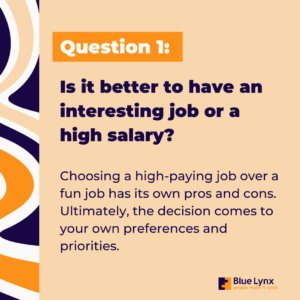
Is it better to have an interesting job or a high salary?
When it comes to career choices, many people wonder whether it is better to have an interesting job or a high salary. Choosing a high-paying job over a fun job has its advantages and disadvantages. Ultimately, the decision comes down to your personal preferences and priorities.
On the one hand, having an interesting and intellectually-challenging job can be incredibly fulfilling. People who find their work to be engaging are more likely to feel a sense of purpose in their daily lives. What’s more, the latest research from the University of Warwick suggests that happiness plays a role in boosting productivity at work. Economists conducted several experiments to evaluate the correlation between employee happiness and work effort. The results of these experiments indicated that individuals who were in a happier state were 12% more productive. Therefore, happier employees may be more motivated to continue learning and growing in their field. Additionally, an interesting job can bring a sense of accomplishment and pride, which can be incredibly rewarding.
On the other hand, having a high salary can mean being able to save more money, exercise different investment options, and have a more comfortable lifestyle. It can also provide more opportunities for travel, leisure activities, and other luxuries. What’s more, a higher salary can provide a sense of security, especially in times of economic uncertainty like the current global recession.
However, having a high salary doesn’t guarantee that you will be happy with your job. A high salary alone doesn’t provide the sense of purpose and accomplishment that many people look for in their careers. Some people may find themselves sacrificing their happiness for higher income and lacking the job satisfaction they had hoped for.
How do you know if you feel fulfilled?
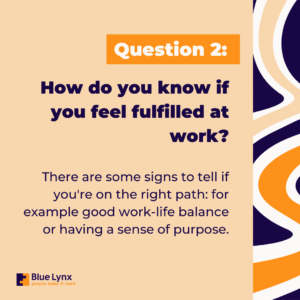
Feeling fulfilled at work is a crucial aspect to consider when evaluating what is more important. High salary or job satisfaction and overall well-being?
One of the most obvious indicators of job fulfilment is finding a sense of purpose. This happens when you feel like your work is meaningful and you’re making a positive impact. Moreover, you may also find yourself more motivated to put extra effort into your daily tasks.
A positive work-life balance is something that most of us don’t really pay much attention to. However, it may only be one of the most important indicators of job fulfilment. Work-life balance represents the relationship between your work and personal commitments, such as family, friends, and leisure activities. Having a good work-life balance means that you can effectively manage your time and responsibilities in both your professional and private life. We all know that if you manage to do so, you’re able to focus better, you have a sense of accomplishment and pride in your work and you’re more productive.
It’s important to note that feeling fulfilled at work is not a one-time event, it’s a continuous process and it can change over time, depending on your circumstances, job or company dynamics.
Finding fulfilment at work is essential for overall well-being and job satisfaction. However, it can be difficult to know where to start.
Here are 5 essential keys to finding fulfilment at work:
1) Having a sense of purpose and feeling like your work makes a positive impact.
2) Feeling challenged and engaged.
3) Continuously learning and growing in your field.
4) Working in an environment that aligns with your values and beliefs.
5) Having a sense of autonomy and control over your work.
By focusing on these key areas, you can increase your chances of finding fulfilment in your career.
What if I don’t want to change careers?
If you’re struggling to evaluate whether it’s time to change careers, consider your motivations carefully first. You could find that it’s not the best course of action in the long run.
It takes a lot of effort, time, and dedication to change careers. It’s possible that the transition between your current employment and your previous one can disrupt many elements of your life. Moreover, it can be so physically and emotionally exhausting that ultimately you start to regret making the change.
Everybody has the option to change occupations at any time in their lives. It’s important to consider whether you’re doing it because of peer pressure or because you recognise it as your own need. Making such major decisions should be motivated by your circumstances.
If your motivations are unclear, you can lack the strength necessary to deal with the inevitable changes and difficulties that come along with career changes.
When do you know you’re thinking of changing jobs for all the wrong reasons:
- You enjoy your work environment, but not your duties
- Responding impulsively to a disruptive event
- Leaving because of a short-term project
- Chasing after a hobby that doesn’t have the potential to bring the bread and butter
- FOMO or peer pressure
Benefits of continuous learning in the workplace
Continuous learning, also known as upskilling, is an ongoing process of acquiring new knowledge, skills, and understanding. In today’s fast-paced global labour market, continuous learning has become more important than ever before. It enables you to adapt to new technologies, stay competitive in your field, and progress in your career.
Why is continuous learning important
- Career advancement
Employers are looking for people who possess a diverse set of skills and can adapt to new technologies.
- Personal growth
Continuous learning can help you develop new skills and knowledge, which can lead to personal growth and self-improvement even outside the workplace
- Economic benefits
Allows you to find your higher earning potential, and achieve better job security.
- Staying competitive
Continuous learning is essential for staying competitive in the job market. After all, you know what they say: “Skills pay the bills”
- Keeping the mind active
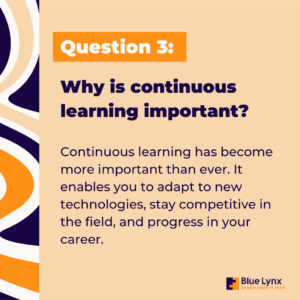
Lifelong learning is key to keeping a healthy brain
According to recent studies, 40% of dementia risk can be influenced by lifestyle choices. Engaging in mental activities and obtaining new skills is important not only because it makes you a valuable employee. It is also one of the most effective ways to promote brain health and improve overall well-being.
Examples of continuous learning in the workplace can take many forms, including formal education, on-the-job training, self-study, or attending workshops and conferences. Whichever method you choose, it is essential for staying competitive in today’s job market
Remote work vs. hybrid work: how do you know which one is right for you
Remote work and hybrid work are two popular work models that have emerged in response to the COVID-19 pandemic.
Remote work involves you working from home or another remote location, typically using digital tools and communication technologies to stay connected with the office and collaborate with colleagues. This model offers increased flexibility and work-life balance for employees. It is also extremely beneficial for employers as it leads to potential cost savings from office spaces and other overhead costs.
Hybrid work, on the other hand, involves a mix of remote and in-office work. Employees may split their time between working from home and working in the office, or they may have the option to choose their preferred work location on a day-to-day basis.
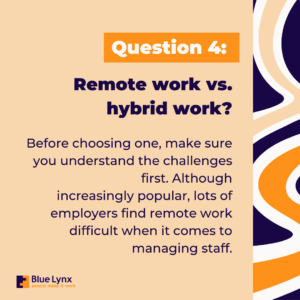
One advantage of remote work is that it can be more convenient and cost-effective for employees. They can work from anywhere with an internet connection and eliminate the need for commuting.
According to research, more than 50% of Dutch workers reside in a municipality other than the one where they work. Nearly 4,5 million of them commute to their places of employment from different cities or provinces, according a poll by Statistics Netherlands.
Remote work also has its challenges. One of the biggest ones is maintaining collaboration and communication among remote employees, which can be difficult when relying on digital tools and technologies. In addition, remote work can lead to feelings of isolation and disconnection from the company and colleagues.
The good news is that hybrid work offers a solution to these challenges, as it provides the benefits of remote work while also promoting in-person collaboration and a sense of community among employees. This can lead to increased employee morale and motivation, as well as improved collaboration and communication.
Embrace quiet quitting or join The Great Resignation
Quiet quitting and The Great Resignation are two distinct examples of quitting a job, and each has its pros and cons. Understanding them can help you make an informed decision on how to navigate a job transition.
According to a recent Gallup study, 50% of the US workforce is quietly leaving their jobs. This is the latest trend in corporate America, as employees refuse to put up with excessive work and decide to set boundaries for their welfare.
Quiet quitting is a trend that refers to the practice of declining effort and engagement in your job. This is often done as a way to prepare to embark on a different career path. This approach is characterised by a gradual reduction in the quality and quantity of work, as well as a decrease in attendance and participation in company events and meetings. Quiet quitting can be a low-risk option if you are looking for a new job or exploring other career opportunities. It allows you to maintain your job security and income while making a transition to the new one.
The Great Resignation, refers to a sudden, dramatic exit from a job, often accompanied by a public announcement. This approach is often adopted by people who have experienced significant stress or burnout. It can also be a result of workplace challenges or conflicts that they believe cannot be resolved. The Great Resignation can be a high-stakes approach, as it involves quitting a job without a plan for the future. It can also hurt your professional reputation and future employment prospects.
One of the cons of quiet is that it can also be viewed as unprofessional and unethical, and it can damage your professional reputation. The great resignation can be a powerful statement of protest or an act of self-care, but it can also be perceived as impulsive and can drive your current and future employer to question your integrity.
When considering a job transition, it’s important to weigh the benefits and risks of each approach and determine what is the best fit for your circumstances unless you want it to backlash.
To sum it up
Choosing a career can be a complex and challenging process. Assessing what kind of work-life balance you’re looking for and the career goals you want to set for yourself in 2023 helps evaluate what your new dream job would look like. Understanding your strengths and weaknesses and recognising your core values will show what kind of an employee you are and how you’d want current and future employers to perceive you.
These 5 career questions aim to help you to be better equipped to make an informed decision that aligns with your passions, skills, and long-term goals. Ultimately, it’s important to remember that your career is not a one-time decision. Rather, it’s a continuous journey, and it’s always possible to make a change if things don’t work out as you expect.
Read More5 mistakes to avoid in your LinkedIn profile
Tip #1: Missing the Аbout section
Your title and the first two lines of your summary section will be the first things readers see.
Adding a summary of your experience, interests, or achievements is very appealing.
In reality, you only have a few seconds to impress a visitor to your LinkedIn profile and grasp their interest, so make sure that what you choose to write there counts. They will click away if you fail to capture their interest, and the opportunity will be wasted. You have 120 characters in your title to briefly introduce yourself and your work.
Pro tip: Don’t make it all about you. People don’t care who you are, they only care about what you can do for them. To do this the right way, make sure you check out their LinkedIn headline fails as well.
So whenever you write a description of yourself, do it from a “what’s in it for me” perspective.
Taking this into consideration, think about how you’d deliver your information, abilities, and experience so that it amply demonstrates how others can benefit from it – be it new clients, partners, groups, or employers.
Speak to your target audience directly. You want potential customers to immediately recognise that they are in the proper location and that you are the expert who can solve their particular problems when they visit your profile.

Be wary of oversharing! It is generally frowned upon when users share personal information on LinkedIn. After all, this is a strictly professional network as opposed to Facebook or Twitter for example.
A decent general rule of thumb is to avoid posting anything on LinkedIn that isn’t business-related unless you want to risk losing the respect and confidence of your contacts.
This is not to say that you should never write anything personal, but do so in moderation and with consideration for your LinkedIn audience.
Other poor communication practices that you may want to steer clear from on LinkedIn include, but are not limited to:
- Spelling mistakes
- Posting complaints (be it about former/ current employer, colleagues or company)
- Content unrelated to jobs
- Personal photos
- Large chunks of text
Tip #2: Career experience that doesn’t match your CV
It’s not only useful but also immensely practical to know how to list work experience that isn’t connected to the position you’re looking for on a resume. You don’t want to mislead talent sourcers by messing up your work chronology, whether intentionally or not. Hiring professionals are receptive to work experience relevant to the current position you may be applying for. Hence, there are specific circumstances in which irrelevant work should be listed, and, if done correctly, can be used to your advantage. Your career prospects may improve if you learn how to combine any unrelated work experience with the one that can be linked to your current application.

Recommendations from previous employers
One of the worst mistakes a job seeker can make is to neglect to use the recommendation option on LinkedIn. Your chances of being recruited or passed over could depend on a reference from a reliable source.
The majority of people dislike talking about themselves. However, failing to share what makes you great at your profession or your personality’s strengths could eliminate you from consideration for that new job or position.
This is why social proof is essential – when introducing a new team member to support their choice to stick with that individual, sourcers rely on the opinions and experiences of other people.
Pro tip: Send a customised message to three to four people who will attest to your quality of work and gladly share positive feedback about their past mutual work experience with you.
Tip #3: Having an empty profile
Did you know that you have about 7 seconds to impress a recruiter?
Imagine you don’t have a profile or background photo, an appropriate job title, a missing surname, etc. – you’d immediately force a sourcers to move on to the next one. Not to mention if your profile doesn’t have the necessary keywords and phrases, you won’t even show in the recruiters’ search.

According to Business Insider, it is of paramount importance to have a profile photo on LinkedIn as that change only gives you already a 7 times greater advantage as opposed to blank profiles. Other mistakes that you can make when choosing profile photos are:
- Using old photos
- Choosing a blurry photo
- Group photos
- Inappropriate attire
Most employers consider LinkedIn to be an online resume, and this is why you should treat it accordingly. Do you think it would make you a good candidate if you send your potential new employer sloppy work before you even started? The way your profile is built says a lot about you and your attitude towards work, so essentially, you’d want to make the best impression and avoid presenting yourself poorly on a reputable social media platform.
It can be tempting to ignore some profile sections, thinking that future employers won’t care about them. However, going above the bare minimum of background information might help you connect with readers and give them a better idea of who you are, what you want to achieve, and what you have to offer.
Tip #4: Not adding your education
Although it may seem like a no-brainer, providing information about your schooling is crucial for creating a LinkedIn profile. Moreover, if you are a recent graduate, that should be one of the first sections of your profile an employer will review. Most positions sourcers recruit for require it. It also serves to strengthen your profile.
Education is important, which is why you need to include a detailed list of your relevant qualifications and academic level on LinkedIn. Not to mention, it will give you a certain advantage over other candidates if you come across fellow graduates.

When writing this section, you should also mention the positions you’ve held and your accomplishments there, but only if they’re relevant to the types of responsibilities you’re going for.
However, rather than just listing the duties of the position, you should emphasise the value you brought to the organisation, and how you contributed to its overall business development and growth.
When describing specific positions in which you may have held responsibility, it’s good practice to use powerful verbs and action words like “managed,” “lead,” and “grew.” They have strong connotations and show that you are able to take responsibility and action as opposed.
Tip #5: Not setting your language proficiency
Nowadays, most job positions require knowing languages to a certain degree. This is the place to showcase your skills. Don’t forget to set the correct level of proficiency. Thankfully, LinkedIn has made it easy-peasy to promote your language skills. You can find them in the “Languages” section under the “Accomplishments” header on your profile.

Aside from boosting your confidence and deepening your connection to other cultures, studies show learning new languages improves decision-making. This is a vital soft skill nowadays and can help you stand out from the crowds. Did you know that bilinguals have notoriously better attention and task-switching capacities?
Being multilingual can provide you with a distinct competitive advantage over other candidates that are monolingual. Regardless of your industry, and degree of competence, they are among the top eight all-time talent features. What is more, the need for multilingual workers is skyrocketing. Actually, the numbers show that American job postings particularly those targeting multilingual workers have increased by over 30% between 2010 and 2015.
To sum it up
It may be daunting to deal with a LinkedIn profile if you don’t know where to start. Our sourcers are rooting for you and have compiled this list of helpful tips. If you follow a simple checklist, you’ll be on the road to success and get discovered in no time. As long as you make sure to follow adequate structure when building your profile, you will have all the vital components of a great and presentable account. Quality photos and clear and truthful work history will create an instant good impression and have recruiters want to know more about you and give you the chance to show off your qualities even further. Regardless of whether you’re a student, a fresh graduate or a job seeker in between long-term contracts, a well-structured checklist should help you avoid detrimental mistakes that most people make when building their LinkedIn profiles.
Read MoreHow to stand out on LinkedIn: 5 tips from a Talent Sourcer
Based on the latest research, over 80% of employers claim that employee referrals offer optimal candidate quality and are decidedly more cost-efficient. Still, according to a LinkedIn report, over 77% of recruiters scout and vet future employees on the platform. What is more, Forbes confirmed that 95% of recruiters search LinkedIn for job candidates. Whether recruiting management or C-level applicants from anywhere in the world, it is easier to do it with LinkedIn.
With over 849.6 million members in 2022, the platform is built entirely to recruiters’ advantage and is often chosen for its sizeable user base. It has become the backbone of recruitment marketing today, as it makes sourcing the right candidates a breeze when used correctly.
Back in the day, it was optional to have an active LinkedIn account. The most common practice by businesses was face-to-face interviews. But today In 2023, those numbers have been steadily increasing. Times change, and we need to keep up, especially with the post-pandemic new normal.
For businesses that are looking to keep up with the fast-changing labour markets and streamline recruitment processes, the value of a well-kept LinkedIn account is indisputable.
If you are wondering what you can do to make your LinkedIn profile stand out, know that you’re in the right place.
Here are 5 invaluable tips on how you can spruce up your LinkedIn profile and wow recruiters at first glance!
Add keywords to your profile
Include relevant keywords in your summary and other sections of your LinkedIn profile. They are a powerful marketing tool that you can use to your advantage. Make sure that your profile is properly optimised for search to make the most of it and increase your chances of getting spotted. What is more, adding keywords to your profile helps sourcers find the necessary information they need fast and easily.
How do I optimise my profile?
To select the right keywords for your account, firstly you should do a thorough search with the relevant titles and jobs. Browse job descriptions related to open positions in your field of expertise. Go for the skills and responsibilities that you come across most frequently and list them in your profile description text.
Why is it important to use the right keywords?
When sourcers search for eligible candidates, they will use certain terms, and if you match them, you will fall onto their radar. Once you have them landed on your profile it’s time to make the best impression.
If you’re wondering where to start from or which keywords make a difference when it comes to attracting the talent-sourcing teams, here are a few pointers that may help you find the right structure:
- Industry name
Anyone who searches for employees with the same job title and responsibilities as you will likely use some of those common words and phrases in their search parameters. Creating a strong LinkedIn profile that uses those terms, you can make yourself more visible to recruiters and others with an interest in locating people in your field.
- Career-specific terms
Most industries have their inherent lingo. This is why it makes sense to include them as keywords in your profile. Whether they entirely portray your competence or just partially, it is vital to have them as a part of your description to ensure better visibility.
- Experience-related vocabulary
If you want to ensure faster and more efficient discoverability, do some quick research on what kind of jargon is used to describe your position in the industry. Hence, if you’re on the hunt for an entry-level job, it wouldn’t make sense to include phrases like “leading a global cross-functional project team” in your LinkedIn profile description.
- Consider your target audience
Be mindful of your tone and the impression that you want to convey to your target audience. Pro tip: You’d want to have an informative yet impactful message. Emojis are a great way to add to that effect.
Have a professional profile picture
You know you have only one chance to make a good impression, and your headline can say a lot about your personality. Appearance matters – a photo of yourself serves as an introduction to who you are, and creates a lasting impression, according to research.
Make sure you have in mind the industry that you are working in when looking for the best LinkedIn profile pictures. It doesn’t have to be the perfect suit and tie image as long as the area that you work in allows certain liberties.
A presentable-looking profile photo is an opportunity to show your audience (and most importantly, potential sourcers) that there is a genuine person behind your online identity. Moreover, according to statistics, LinkedIn users with photos benefit from greater engagement; they’d get as many as 21 times more views on their profiles and 9 times as many connection requests.
Highlight your skills
Remember how we talked about keywords earlier? LinkedIn must categorise you as a professional in some manner, so the algorithm searches through your profile for mentions of particular keywords. The more often a term is used, the more LinkedIn believes you are an expert in that field.
What’s more, your skills are one of the top things sourcers will look at.
Just like in your CV, how will they know what you are capable of if you don’t put it out there?
Your LinkedIn profile allows you to highlight your talents, abilities, and knowledge. It can help show off your abilities in a manner that a resume cannot.
Add any certificates you have
These are the valuable accomplishments that will give you an advantage. Invest in learning something new or certify a skill you already have.
A well-written profile can highlight your qualifications in a given industry, and highlight any certificates, honours, or accreditations that you have received. And it can help identify any unique assignments or duties you have held at work, therefore helping recruiters assess how eligible you may be for a particular job.
Ultimately, it helps people find your profile faster and will ensure that you find your next dream job in no time.
What kind of skills to add to your profile?
- Skills that are trending for your industry (both soft and hard)
Pro tip: Examine the job descriptions for the positions you are interested in to figure out the ones that are right for you.
- Universal skills
Think about what skills can you transfer from your previous job to the new one. Skills that are universal and can be applied to different fields (time management, giving/receiving feedback, etc.) You can transfer these talents from one job to another, even if they are in completely different roles.
For instance, positions in sales can frequently be transferred from customer service. Communication skills can develop through de-escalation.
Pro tip: Try not to fall into overusing terms like “excellent communicator”; everyone is easily put off by clichés.
Don’t forget the Open-to-work filter
This tool helps you inform potential employers, recruiters, and others in your network that you’re looking for work. You do this by selecting either “share with recruiters exclusively” or “share with all LinkedIn members”.
That green banner is extremely useful and eye-catching. It lets sourcers know you are open to being contacted.
Is it good or bad to be open to work on LinkedIn?
Robert Hellmann, Career & Executive Coach, recommends selecting ”Share with recruiters only” according to his article on Forbes. Based on his experience in training recruiters, he claims that they do use the open-to-work field in their talent searches on the platform.
To sum it up
LinkedIn is a straightforward, yet powerful, and simple-to-use tool that can help you find your dream job. If you follow our 5 tips and examples of how to stand out on the platform, you will be easily noticed in a sea of applicants. It will help you advertise your knowledge and abilities, and demonstrate to potential new employers how you can help their businesses become more successful. Visitors should find your page visually appealing and find it simple to understand who you are and what you can actually accomplish for them professionally. Ultimately, these LinkedIn profile-building tips aim to give you a head start on creating a strong profile and ensure your long-term success.
Read MoreMake the Perfect Curriculum Vitae: Design your CV like a Pro and Land Your Dream Job
In order to own the perfect CV, you must focus on several strategical points, which for sure include distinctive design, nice layout, well-structured and organised content and don’t forget to focus on what matters, keep it simple. Because when it comes to designing your CV – LESS IS MORE. Don’t worry, it is easier than you think.
Here are our 8 tips for being one step closer to the ideal CV:
Tip #1: More skills-focused CV
Concerning the content, never skip the “Skills” section in your curriculum vitae. Employers are changing their recruitment strategies and the focus of companies is now the skills set, including the hard and the soft skills of the candidates needed for a long-term success in a role.
Hard skills, also called technical skills, are specific to the particular job, relevant to each position and seniority level. Soft skills, on the other hand, are general characteristics, relevant to personality traits, which can make sense in certain jobs, while being less important in others.
Tip #2: CV targeted at specific job
You better have a distinctive CV design, but don’t underestimate the uniqueness of your content as well. Forget about the generic resume that you create and send out to a dozens of employers. Stand out and show them how uniquely qualified for the position you are.
We recommend careful examination of the job listing of the open position for keywords. These keywords are important and powerful tool if included in your CV as well, without using them excessively, of course, but they play a vital part in showing that you can handle the work if hired.
Tip #3: Choose the perfect font
Since your curriculum vitae is the first thing a potential employer will see, you want every aspect of it to speak to who you are. The font you choose for it plays a big role in what the reader will think about you. Using more than 2 different fonts can make your CV look unstructured and unprofessional.
The 2 most important categories of fonts are Serif and Sans Serif. Serif fonts are considered more classic and formal, while sans-serif fonts are often considered more minimalistic. Serif fonts are easier to read in print, while Sans Serif fonts are easier to read online.
If for example, you’re analytical and technical, try using a sans serif font, but also keep in mind that Sans Serif fonts are always the safe choice and definitely stay away from fonts like Comic Sans and Script.
Another point to emphasise is the font size. Always try to use bigger font size for the headings of the different sections. Having these distinct sections makes the design easy to navigate, allowing readers to quickly scan for information. You can also bold your text to make it look even more impactful and create a visual hierarchy. Set the spacing for 1.15 or 1.5. Make sure it’s consistent across your whole resume design.
Tip #4: Add visual emphasis to your info
As we mentioned, it is important for the reader to be able quickly and easily to find what matters for them as information. Using icons, makes your CV look more creative and at the same time helps for a fast navigation. Icons are often used instead of bullet points or where it is clear what you want to say with the help of one icon. You can also use it in place of a word, in the Interests section for example, where there is no need for a lot of details.
Infographics are also a good choice when we need to save space or to represent our information in a more pleasant and creative way.
Last but not least, using colors in your design and fonts can make your curriculum vitae stand out and tell more about your personality to the reader. Try not to use more than 2 colors or up to 3 if only one of the colors is an accent color.
Tip #5: Make content skimmable
The human brain is bombarded with content from the moment we wake up to the moment we go to sleep. So, we found a way to cope with all of it by skimming content to get the essence. CVs are no different. Research shows that HR representatives will spend about six seconds on your curriculum vitae. Make the most of it by ensuring your CV is skimmable. Don’t try to cram too much text into too little space.
It will also look easy to read if the content is divided into sections and only the most important and relevant information should be included with the help of bullet points. Make sure you have enough white space and avoid information overload. We suggest going for an extra space before and after every heading and each entry. In general, your resume should be no longer than a page.
Tip #6: Use the right file type
Always check the job description to ensure that resumes in PDF are accepted. PDF files help you keep your resume layout intact. Also, PDFs are a safer choice for infographic CV designs or others made with advanced graphic design software than JPG or PNG files. If not, you can always send a resume in Word or another format, but only if needed. Either way, having two CV file formats is always a good idea.
Plus, keep in mind that a great cover letter that matches your CV will give you an advantage over other candidates.
Tip #7: Simple design
When it comes to your CV, a simple design will always be more professional and effective than something unconventional that can also seem too extravagant and inappropriate for the particular job.
A major design resume trend to be mentioned is that many companies use applicant tracking systems (ATS) and it is going to be important for jobseekers to learn to use a resume format that is readable by ATS. However, a simple well-organized resume doesn’t mean it is a boring one to look at.

Tip #8: Interests section help you stand out
Your CV isn’t just about listing your former roles and skills, it’s also about how you will relate to the company culture proving your worth to the potential employer. While a strong job history does prove a certain level of competence in your field, it’s your hobbies and interests that will help you stand out from the rest of the competing candidates. Include only your interests and hobbies that you think align with the desired personality traits.
Read More